
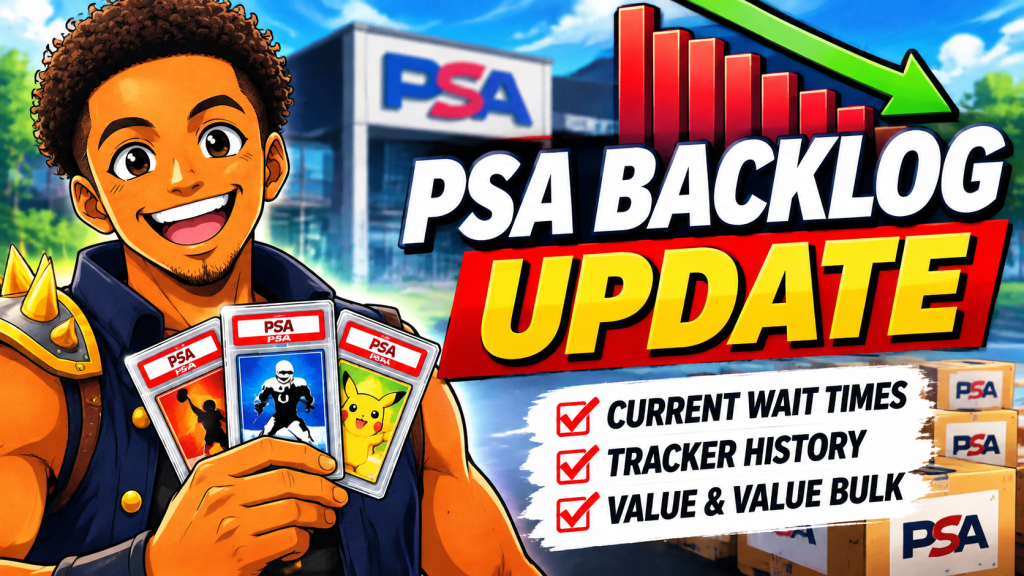
The latest PSA backlog update gives collectors a clearer picture of how the grading company is working through its submission queue, reopening lower-priced services, and managing demand. For anyone waiting on an existing order or considering a new submission, the official PSA Backlog Tracker provides an important reference point. However, understanding the backlog requires more than looking at one number. Collectors also need to consider service-level priorities, estimated turnaround times, and the difference between orders already in PSA’s system and new submissions entering the queue.
This guide tracks official PSA backlog figures over time, explains what the latest changes mean for collectors, and provides a reference that can be updated as PSA publishes its next biweekly report.
Latest PSA Backlog Update: November 15, 2026
Latest official tracker figure
PSA active grading backlog
6.8 million
Down from 7.2 million
November 3, 2026
PSA’s latest published tracker update reports a reduction of approximately 400,000 units from the previous report.
Source: Official PSA Backlog Tracker. Checked November 15, 2026.
As of November 15, 2026, PSA has not published a newer tracker figure than its November 3 update. The official tracker says it is updated biweekly, making another update due around November 17. The November 3 report states that daily grading output remained consistent, although the backlog declined more slowly because submissions increased after Value reopened.
Importantly, PSA says existing orders remain prioritized ahead of new Value submissions. It also says continued operational momentum will position the company to evaluate reopening Value Bulk in the coming months. That language indicates progress, but it does not establish a reopening date.
PSA Value Reopening and Current Service Availability
The following information reflects PSA’s official pricing page as of November 16, 2026. These are current published terms for new submissions, not revised delivery estimates for cards already in the grading queue. For the complete pricing and estimated turnaround details across all PSA service levels, see our PSA Card Grading Guide.
PSA Value reopened on October 29, 2026, at $39.99 per card in the United States. Its published estimated turnaround is 90-100 business days. PSA’s turnaround estimates are not guarantees and may change with submission volume and available capacity.
For current pricing and turnaround information across PSA’s grading services, including Standard, Priority, Express, and premium tiers, visit our PSA Card Grading Guide.
Important: PSA’s estimated turnaround times are estimates only, not guarantees. Actual processing times can change with submission volume and available capacity. All published turnaround estimates use business days, not calendar days. For the latest service-level pricing and estimated turnaround information, refer to our PSA Card Grading Guide.
The Value service reopened on October 29, 2026, at 8 a.m. Pacific Time. Its U.S. price is $39.99 per card, with a $500 maximum insured value and a 90-100 business-day estimated turnaround. PSA also specifies a 120-business-day estimate for Value submissions in Japan.
What is happening with PSA Value Bulk?
Value Bulk remains paused as of November 15, 2026. PSA describes it as a Collectors Club-only bulk service covering all categories, including trading card games. The company has committed to reopening it, but has not announced an official reopening date.
The November 3 tracker update says PSA will evaluate reopening Value Bulk in the coming months if it maintains its operational momentum. Collectors should therefore distinguish between an expressed intention to reopen the service and a confirmed date when submissions will become available.
There is currently no verified Value Bulk price or turnaround estimate to publish as an active submission option.
Official references: PSA Backlog Tracker, PSA Submission Updates, and PSA Trading Card Grading Prices. All checked November 15, 2026.
3. PSA Backlog Tracker: Complete Update History
The PSA backlog has not declined in a perfectly straight line. In fact, the official tracker shows that the backlog increased during parts of the summer before beginning a sustained downward trend. That history matters because it gives collectors more context than a single reporting period.
The following timeline preserves the official reporting dates and figures so readers can compare future PSA card grading backlog updates against earlier announcements.
| Official update date | Reported backlog | Official context |
|---|---|---|
| June 2, 2026 | Approaching 10 million | PSA announced a temporary pause of Value tiers following a 20% submission spike. It launched the public tracker and announced a $200 million capacity investment. |
| June 8, 2026 | Not reported | PSA said opening Value and Value Bulk packages could take 6-8 weeks before items entered grading. |
| June 30, 2026 | Approximately 12 million | PSA reported that the backlog was trending downward. |
| July 14, 2026 | 11 million | PSA reported accelerating output and progress toward record monthly grading volume. |
| July 28, 2026 | 12.4 million | The backlog increased. PSA cited higher-tier submissions, shipments arriving within the 45-day eligibility window after the initial pause, and convention-season volume. Its Plano, Texas grading facility also opened. |
| August 11, 2026 | 11.85 million | PSA reported another reduction and said July had surpassed June’s record for monthly graded units. |
| August 25, 2026 | Approximately 10.9 million | PSA reported steady daily output across five grading hubs. |
| September 8, 2026 | 9.9 million | PSA reported a reduction from approximately 10.9 million. |
| September 22, 2026 | Approximately 9 million | PSA reported continued progress and discussed its Frankfurt facility. Existing Value and Bulk orders retained priority over new Standard submissions. |
| October 6, 2026 | 8.2 million | PSA reported a reduction from 9 million. |
| October 20, 2026 | 7.2 million | PSA reported increased scale and efficiency. Existing orders would remain prioritized ahead of new submissions. |
| November 3, 2026 | 6.8 million | PSA reported consistent daily output, but a slower backlog reduction following increased submissions after Value reopened. |
Source for historical figures and official context: PSA Backlog Tracker. The June 2 announcement described a projected 5-6 month path toward a 5 million-unit target. That historical projection should not be treated as a binding reopening requirement.
Understanding the direction of the PSA backlog
The July 28 update is particularly important. It demonstrated that a growing backlog does not necessarily mean grading capacity has stopped improving. PSA attributed that increase to incoming submission volume and shipments arriving after the initial service pause.
After reaching 12.4 million, the official figures moved downward through August, September, October, and early November. By November 3, the reported backlog had fallen to 6.8 million. The following table summarizes the official backlog history in millions of units.
Official PSA backlog figures in millions of units. June 2 is shown as approximately 10 million because PSA described the backlog as approaching that level.
| Date | Official backlog in millions |
|---|---|
| June 2, 2026 | Approximately 10 |
| June 30, 2026 | Approximately 12 |
| July 14, 2026 | 11 |
| July 28, 2026 | 12.4 |
| August 11, 2026 | 11.85 |
| August 25, 2026 | Approximately 10.9 |
| September 8, 2026 | 9.9 |
| September 22, 2026 | Approximately 9 |
| October 6, 2026 | 8.2 |
| October 20, 2026 | 7.2 |
| November 3, 2026 | 6.8 |
The chart illustrates the broader direction of the queue. However, it does not show how many cards belong to individual service levels, how many submissions are awaiting intake, or how long a particular collector’s order will take.
That distinction is essential when interpreting the PSA backlog tracker. A declining total is encouraging operational information, but it is not an individual order-status forecast.
4. What the PSA Backlog Means for Collectors
The practical impact depends on where a collector sits in the submission process. Someone who submitted months ago faces a different situation from someone considering a new Value order or waiting for Value Bulk to return.
If your cards are already at PSA
Existing submissions should be evaluated under the service terms associated with the original order. PSA explicitly stated that reopening Value does not change the delivery estimates for existing submissions.
Furthermore, PSA says existing orders retain priority ahead of new Value submissions. This is an important distinction because reopening a lower-priced service does not automatically place newly submitted cards ahead of collectors who have already been waiting.
If your order is past its estimated turnaround time, monitor your PSA account and official communications. The backlog figure provides broader operational context, but it cannot establish when an individual order will finish.
If you are considering a new PSA Value submission
Value’s return at $39.99 per card gives collectors another lower-priced grading option. However, the price alone should not determine whether a submission makes financial sense.
Consider the card’s condition, potential grade, current market value, and maximum insured value. You should also evaluate the estimated turnaround against your collecting or selling timeline. For current pricing, service limits, and turnaround estimates across PSA’s grading tiers, consult our PSA Card Grading Guide. A lower grading fee can improve the economics of a submission, but it does not automatically make every card a worthwhile candidate.
For a deeper breakdown of the cost, grading economics, and potential return, see our guide: PSA Value Grading Is Back at $39.99.
If you are waiting for PSA Value Bulk
Value Bulk is a different decision. It is intended for Collectors Club members submitting cards in bulk, and its continued pause leaves some collectors waiting for a lower-cost submission route.
PSA has indicated that it intends to evaluate reopening the service in the coming months. However, without a confirmed reopening date, collectors should avoid building a submission schedule around an assumed launch.
Instead, organize potential submissions and assess whether the currently available Value service makes sense. If Value Bulk returns, you can compare its official price, eligibility requirements, and turnaround estimate against the alternatives available at that time.
Most importantly, do not confuse the historical 5 million-unit target with a confirmed reopening trigger. PSA reopened Value while the reported backlog was still above that figure. Its current Value Bulk language is an evaluation of progress, not a guaranteed threshold or schedule.
5. Should You Submit Now or Wait?
There is no universal answer because the right decision depends on the card, the grading budget, and the reason for submitting.
For collectors with cards that have a strong grading case and a clear financial or collecting purpose, Value may already provide a reasonable option. On the other hand, collectors whose economics depend heavily on bulk pricing may prefer to wait for more information.
Consider these factors before deciding:
- Card value: Does the potential graded value justify the submission cost?
- Condition: Does the card have a realistic chance of receiving a grade that supports your expectations?
- Time horizon: Can you comfortably wait through the published turnaround estimate?
- Service eligibility: Does the card fit the service’s maximum insured value and other requirements?
- Alternative grading options: Would another grading company or submission route make more sense?
For a wider comparison, our Card Grading Companies 2026: Best Value Comparison examines the different grading options collectors can consider.
There is also an alternative route worth understanding. Collectors who prefer an in-person retail submission option can review our GameStop PSA Grading Cost guide before choosing how to submit.
The official PSA submission process still matters
Once you have decided to submit, the next consideration is preparing the cards correctly. This article focuses on the backlog and service availability rather than repeating the full submission process.
For the actual submission steps, service selection, packaging requirements, and pricing context, use the PSA Card Grading Guide.
6. Why This Matters to Collectors
The PSA backlog affects more than turnaround expectations. It influences when collectors can access lower-priced grading, how they plan their submission budgets, and whether certain cards still make financial sense to grade.
Moreover, a large backlog can change how collectors approach their entire submission strategy. Instead of sending every potentially gradable card immediately, collectors may become more selective about condition, market demand, and expected return.
However, the most important lesson is that the grading process begins before PSA receives a card. Collectors control the preparation decisions that happen at home, including how they handle, sleeve, protect, organize, and package their cards.
That stage deserves particular attention because grading outcomes can be influenced before a card ever reaches a grader. Surface scratches, damaged corners, and edge wear introduced during preparation can create problems that no turnaround improvement can reverse.
Consequently, the backlog should encourage more thoughtful submission planning, not rushed preparation.
7. A Better Way to Prepare While You Wait
A large grading queue can create a temptation to rush once a service becomes available. However, collectors can use the waiting period productively by reviewing their cards, identifying strong submission candidates, and organizing their preparation materials.
A consistent preparation process helps collectors avoid unnecessary handling and reduce preventable submission mistakes. In particular, cards should receive appropriate sleeves and semi-rigid holders, with attention to clean handling and organized packaging.
This is where the Graders Choice Submission Kit fits naturally into the process.
Prepare the Card Before You Enter the Queue
The Graders Choice Submission Kit is designed as an all-in-one prep and submit system for collectors who want a structured approach before sending cards to grading companies.
It includes:
- 20 penny sleeves
- 20 semi-rigid card holders
- Microfiber cloth
- Shock-absorbent foam protection
- Self-seal shipping box
- Clear PSA barcode-placement sticker, when needed
The kit supports preparation for PSA, CGC, Beckett, SGC, TAG, AGS, and other grading services. Its purpose is to bring the preparation materials together in one organized system rather than requiring collectors to assemble random supplies.
Explore the Graders Choice Card Grading Submission Kit.
The important point is not simply having the right supplies. It is developing a disciplined process that protects cards during the stage collectors control most directly.
8. What Collectors Should Do Next
As PSA continues publishing biweekly tracker updates, collectors should use the official figures as a reference rather than a personal turnaround calculator.
Here is a practical approach:
- Check the official tracker: Compare the newest figure with the previous update and note the reporting date.
- Review your existing orders: Use your PSA account for order-specific information rather than relying on the overall backlog.
- Compare current service levels: Review the PSA Card Grading Guide for current service pricing, maximum insured values, and estimated turnaround times.
- Monitor Value Bulk: Wait for an official reopening announcement before assuming the service is available.
- Prepare your cards: Organize your potential submissions and use appropriate protective materials before choosing a submission date.
For the latest information, bookmark the official PSA Backlog Tracker and PSA Submission Updates.
Conclusion: Follow the Queue, but Control Your Preparation
The PSA backlog has moved from a summer high of 12.4 million units to 6.8 million in the November 3 official update. That represents meaningful progress, although the pace of reduction has moderated as Value submissions have returned.
For collectors, the important questions are now how quickly PSA can continue reducing the backlog, when Value Bulk might reopen, and whether current grading prices and estimated turnaround times make a new submission worthwhile.
Ultimately, successful submission planning involves more than choosing a grading tier. Collectors should understand the queue, evaluate the economics, and prepare their cards carefully before sending them away.
The backlog determines the environment in which collectors submit. Preparation determines how carefully they protect their cards before grading begins.
Graders Choice is built around that preparation stage, providing a structured way to prep and submit with confidence while keeping card protection at the center of the process.
 English