
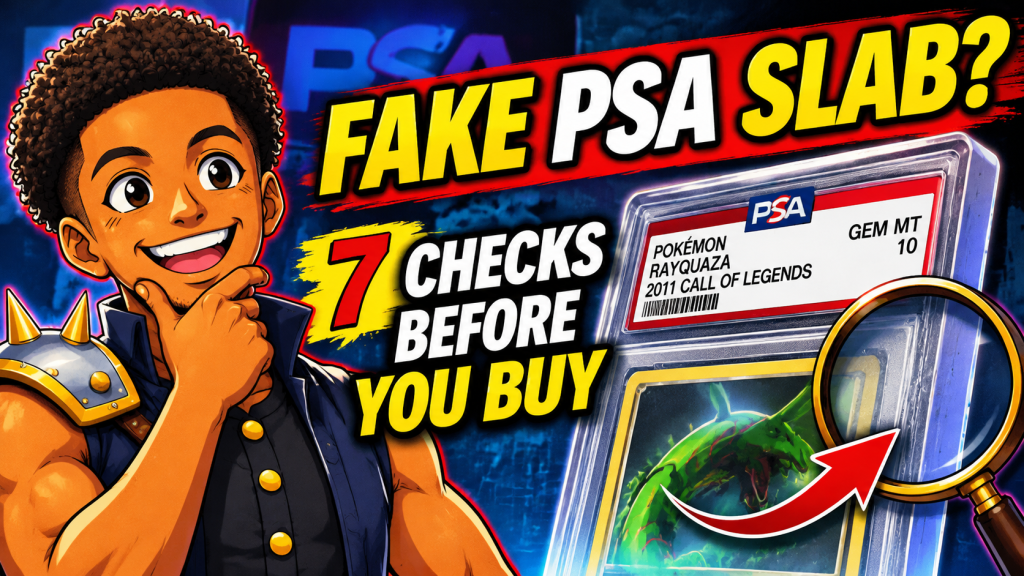
A high-value graded trading card can represent a significant investment, but the plastic holder surrounding it deserves just as much attention as the card itself. The possibility of a fake PSA slab is an important consideration for collectors purchasing expensive graded cards, particularly when a transaction involves a private seller, online marketplace, or limited opportunity for physical inspection.
A recent allegation involving a Shiny Rayquaza represented as a PSA 10 has brought renewed attention to this issue. However, the most important lesson extends beyond one transaction: collectors should understand how to evaluate a graded card’s holder, verify its certification information, and recognize when a purchase deserves additional scrutiny.
Just as importantly, a potentially counterfeit or tampered slab does not automatically mean the trading card inside it is fake. These are separate questions, and responsible buyers should evaluate them independently.
The Rayquaza Allegation: Why Slab Security Matters
On November 3, 2026, Dexerto published a report by Connor Bennett concerning collector Jesse Peng and a 2011 Call of Legends Shiny Rayquaza represented as a PSA 10.
According to the Dexerto report, Peng purchased the card for over $660,000. The article attributed the following statement to Peng:
“The card is real, the label is real, the only thing that they couldn’t do is get the fugitive ink right.”
Peng’s statement describes an allegation concerning the physical holder’s security features. He specifically characterized the card and label as real while raising a concern about the holder. His statement should not be interpreted as independent confirmation that the physical slab was counterfeit or that fraud was conclusively established.
The distinction matters. A genuine trading card can potentially sit inside a questionable holder, just as a legitimate-looking label does not independently establish that the surrounding slab is authentic.
Dexerto credited YouTube/PDGR as its source. The underlying video has not been independently verified for this article, so the account should be understood as a reported allegation rather than a firsthand inspection or independently established finding.
The story is useful because it highlights a broader issue in graded-card collecting: buyers must evaluate more than the grade printed on a label.
Fake PSA Slab vs. Fake Trading Card: Understanding the Difference
Before examining security features, collectors should understand the difference between a counterfeit trading card and a potentially counterfeit or tampered grading holder.
These are two distinct concerns.
A fake trading card is a reproduction or counterfeit card designed to resemble an authentic collectible. Its artwork, printing, surface, construction, or other characteristics may differ from a genuine example.
A fake or tampered PSA-style slab involves concerns about the grading holder, its label, its construction, or the relationship between the holder and the card inside.
For example, a genuine Pokémon card could theoretically sit inside a holder that someone has altered or replaced. Likewise, a genuine-looking PSA label and certification number do not automatically establish that the physical holder is legitimate.
Therefore, collectors should evaluate three separate elements:
- The card: Does the actual collectible appear consistent with an authentic example?
- The label: Do the printed identification details correspond to the card and its claimed grade?
- The holder: Does the physical case show characteristics consistent with the relevant PSA holder generation?
A positive answer to one question does not resolve the others.
This distinction becomes especially important when purchasing high-value cards. Buyers should avoid treating a legitimate certification lookup as a substitute for examining the physical item.
1. Check the PSA Certification Number
The first practical step when evaluating a potentially fake PSA slab is to use PSA’s official certification verification service.
Visit the official PSA certification lookup.
Enter the certification number printed on the slab and carefully compare the returned information against the item being offered.
Pay attention to:
- The card’s identity.
- The release year.
- The set or series.
- The card number or other identifying information.
- The assigned grade.
- Available certification images.
If the information does not match the physical card or the seller’s description, pause the transaction.
However, a matching certification number does not prove that the physical slab is authentic.
PSA specifically warns that counterfeit holders can carry certification numbers copied from genuine, publicly available records. In other words, someone can reproduce a legitimate certification number without possessing the original graded card.
A QR code that directs buyers to a genuine PSA webpage presents the same limitation. It can help confirm that a certification record exists, but it cannot independently authenticate the physical holder.
The important distinction: Certification verification checks the record. It does not conclusively authenticate the physical item in front of you.
PSA also explains that its certification verification service does not eliminate the risks associated with purchasing cards online. PSA does not inspect individual web-listed items or warrant their authenticity.
2. Examine the Physical Holder and Its Construction
After checking the certification record, examine the slab itself.
PSA has introduced different holder designs and security features over time. Consequently, collectors should not assume that every genuine older slab must display every feature found on a newer holder.
This is particularly important when evaluating vintage graded cards or older PSA holder generations.
PSA’s official holder security overview provides information about its security features and holder evolution.
When examining a potential purchase, look for visible signs that deserve additional investigation.
These include:
- Cloudy or frosted-looking seams.
- Visible fractures or cracks.
- Edges that appear compromised or potentially opened.
- Unusual separation around the holder’s construction.
- Physical damage that does not match the seller’s explanation.
PSA’s security buyer’s guide discusses these types of concerns and explains the importance of examining the holder.
Importantly, these observations are warning signs, not definitive proof of tampering.
A damaged slab does not automatically mean someone altered it. Likewise, a holder that appears clean and undamaged is not automatically authentic.
PSA describes its holders as tamper-evident rather than tamper-proof. That distinction is important because security features can help reveal potential interference without making every form of manipulation impossible.
Collectors should also consider the age and design generation of the holder before drawing conclusions.
3. Do Not Rely on Photos Alone
Online photographs can help collectors screen potential purchases, but they cannot establish the authenticity of a physical slab.
A seller might provide clear images of the front, back, label, and certification number. Those images can help buyers compare visible details and identify obvious inconsistencies.
However, photographs have important limitations.
A picture cannot reliably establish the integrity of every seam or demonstrate all physical characteristics of a holder. Certain features may also depend on viewing angle, lighting, and physical inspection.
Furthermore, a photograph does not prove that the seller actually possesses the exact item pictured.
For that reason, buyers should request additional photographs when something looks unusual. Consider asking for:
- Clear front and back photographs.
- Close-ups of the label.
- Images of the holder’s edges and corners.
- Additional views of any area that appears damaged or inconsistent.
- A current photograph showing the actual item in the seller’s possession.
These requests can improve the quality of a preliminary assessment.
Nevertheless, even an extensive photograph collection cannot replace a physical examination when the transaction involves significant value or unresolved concerns.
4. Understand PSA Holder Generations
One common mistake collectors make is assuming that every authentic PSA slab should look identical.
That assumption creates unnecessary confusion.
PSA has evolved its holder designs and security features over time. Older genuine slabs may differ from newer examples in appearance, construction, and security characteristics.
As a result, buyers should consider the holder’s generation when evaluating an item.
A feature that appears different from a modern slab does not automatically indicate counterfeiting. Equally, a holder that resembles a familiar modern design does not automatically establish authenticity.
Collectors interested in understanding these changes can review our overview of the PSA card slab upgrade and new holder design.
The purpose of understanding holder evolution is not to memorize a single appearance or security feature. Instead, it helps buyers avoid making conclusions based on outdated assumptions.
When a holder’s design raises questions, compare it with relevant official PSA information and seek qualified assistance if necessary.
5. Evaluate the Seller and the Transaction
The seller deserves as much attention as the slab.
A legitimate-looking certification record and attractive photographs do not eliminate the importance of evaluating the person offering the card.
Before completing a purchase, consider the following questions:
- Does the seller have an established history of trading graded cards?
- Can the seller provide additional photographs of the actual item?
- Does the seller answer reasonable questions about the card and holder?
- Does the transaction provide meaningful buyer protection?
- Is the seller willing to allow an appropriate independent inspection?
- Does the seller’s description accurately reflect the condition of the card and slab?
Also, pay attention to the circumstances surrounding the offer.
An unusually attractive price, pressure to complete a transaction immediately, or resistance to reasonable verification requests should encourage additional caution.
None of these circumstances independently proves fraud. However, together they can help buyers decide whether the transaction deserves further investigation.
For expensive graded cards, the seller’s reputation and willingness to support reasonable due diligence should form part of the purchasing decision.
6. Know When to Seek Professional Review
Sometimes the available information will not provide a clear answer.
A certification number might match. The photographs might look convincing. The seller might have a reasonable explanation for an older holder or visible damage.
Yet, something about the physical slab may still raise questions.
In these circumstances, collectors should avoid forcing a conclusion.
Instead, consider arranging a professional review before completing the purchase. Look for an appropriately qualified grading or authentication professional who can assess the specific concerns.
The availability, cost, and timing of professional review can vary. Buyers should establish those details before relying on a review as part of a transaction.
Most importantly, do not attempt to test the holder yourself by bending, flexing, prying, cracking, applying chemicals, or trying to open it.
These actions can damage the collectible and introduce additional uncertainty.
A cautious buyer recognizes when personal inspection has reached its limits.
Why This Matters to Collectors
Graded cards carry two different forms of confidence.
The first comes from the grading company’s assessment of the card. The second comes from the buyer’s confidence that the physical item being purchased corresponds to that assessment.
Both matter.
A PSA 10 label can influence how buyers perceive a card’s condition and market value. However, the label alone should never replace independent purchasing judgment.
This becomes particularly important when transactions involve expensive Pokémon cards, vintage sports cards, rare trading card game releases, or other collectibles with substantial collector demand.
The submission and grading process also plays an important role in this discussion. Collectors should understand how grading works, what a grading company evaluates, and what happens before a card receives its final holder.
Our PSA card grading guide provides additional context about the grading process.
Ultimately, trust in graded collectibles depends on more than a number printed on a label. It requires confidence in the card, the holder, the certification record, and the transaction itself.
What Collectors Should Do Next
Before purchasing an expensive graded card, use a consistent evaluation process rather than relying on a single security feature.
Here is a practical pre-purchase checklist:
- Identify the card. Confirm the year, set, card number, and other identifying characteristics.
- Verify the certification. Use PSA’s official lookup and compare all available information.
- Examine the label. Look for inconsistencies between the printed information and the certification record.
- Inspect the holder. Review its visible condition, seams, edges, and construction.
- Consider the holder generation. Account for historical changes in PSA holder designs.
- Request current photographs. Confirm that the seller can show the actual item from multiple angles.
- Evaluate the seller. Consider transaction history, reputation, communication, and available buyer protections.
- Seek professional review. If significant concerns remain, arrange an appropriate inspection before purchasing.
Remember that no single step guarantees authenticity.
A matching certification number, genuine-looking label, QR code, clean holder, or convincing photograph cannot independently establish that a physical slab is authentic.
The goal is to combine available evidence, recognize uncertainty, and avoid purchasing when important questions remain unanswered.
A Better Approach to Card Preparation and Submission
For collectors who also submit their own cards for grading, careful preparation is an important part of the process.
Handling, sleeving, inserting cards into holders, and preparing packages all require attention. These steps concern the condition and organization of a collector’s own cards before they reach a grading company.
Preparation does not authenticate an existing slab, establish whether a previously graded card is genuine, or protect against counterfeit holders. Those concerns require separate verification and evaluation.

The Graders Choice Card Grading Submission Kit brings essential preparation and shipping supplies together in one organized system.
The kit is designed for the practical work of preparing cards for grading. It is preparation and shipping gear, not an authentication service, counterfeit detection product, or guarantee of shipping or grading outcomes.
For collectors who decide to submit cards themselves, appropriate materials and a consistent preparation process can help bring greater organization to the submission experience.
Conclusion: Verify More Than the Number on the Label
The recent Shiny Rayquaza allegation is a useful reminder that graded-card buyers should look beyond the grade printed on a PSA label.
A genuine card, a legitimate-looking label, a matching certification number, and an authentic physical holder are separate considerations. Collectors should evaluate each one carefully rather than assuming that a positive result in one area resolves every other concern.
When purchasing a potentially high-value collectible, take the time to verify the certification, examine the holder, understand its generation, evaluate the seller, and seek professional assistance when necessary.
Ultimately, the best protection for collectors is a disciplined purchasing process. Confidence should come from careful evaluation, not from relying on a single security feature or assuming that every graded card is exactly what it appears to be.
 English