
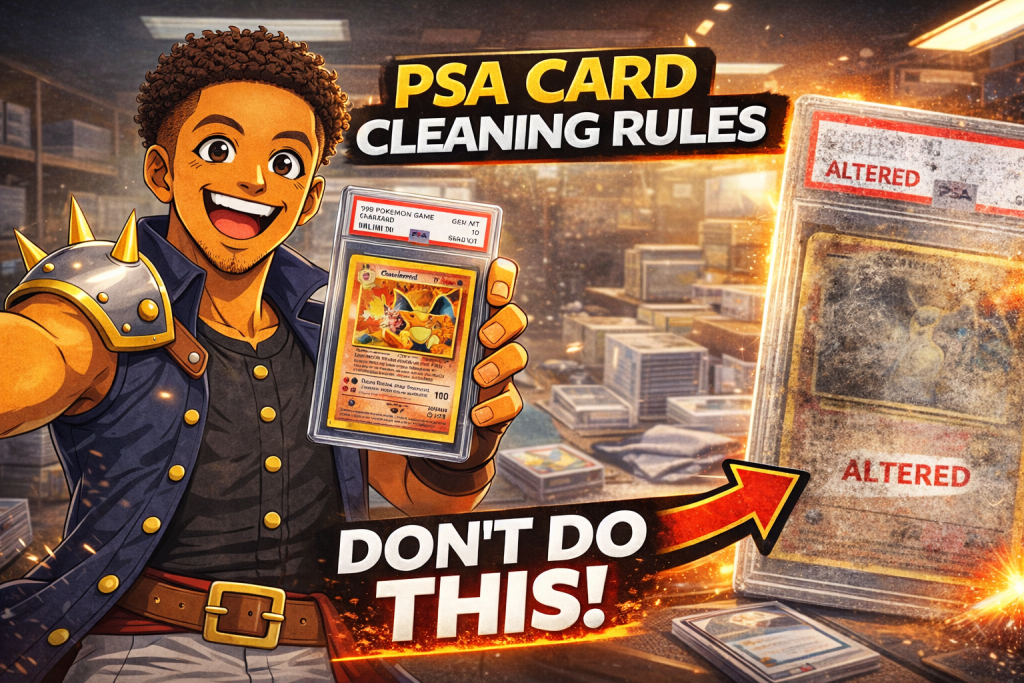
PSA Card Cleaning Rules Updated: March 2026
- What Are PSA Card Cleaning Rules
- Why Cleaning Falls Under PSA Alteration Rules
- Common Cleaning Mistakes Collectors Make
- What Happens If PSA Detects Cleaning
- PSA Has Final Authority Over All Decisions
- Why PSA Card Cleaning Rules Matter
- What Collectors Should Do Instead of Cleaning
- The Submission Stage Is Where Risk Increases
- FAQ: PSA Authenticity and Alterations Rules
- Conclusion
PSA card cleaning rules shape one of the most misunderstood parts of card grading. Many collectors try to improve a card’s appearance before submission without realizing the risk involved. In many cases, that decision leads to rejected submissions or altered designations.
PSA outlines these standards in its official Terms and Conditions, which you can review here: https://www.psacard.com/termsandconditions. If you want a broader understanding of how grading works alongside these rules, you can also reference this complete guide: https://graderschoice.com/psa-grading-guide/
The key issue is simple. Actions that seem harmless, like cleaning a surface or removing minor flaws, often fall under PSA’s definition of “doctoring.” Once a card crosses that line, the outcome changes.
What Are PSA Card Cleaning Rules
PSA card cleaning rules fall under a broader standard focused on preserving originality. Cards must remain in their original, unaltered condition to qualify for grading.
PSA defines doctoring as any action that changes the appearance, condition, or structure of a card. This includes trimming, recoloring, bleaching, cleaning, waxing, power erasing, re-backing, and other restoration efforts.
This definition removes ambiguity. It does not rely on intent or severity. If the card shows evidence of change, PSA may treat it as altered.
Why Cleaning Falls Under PSA Alteration Rules
Many collectors assume cleaning is part of responsible preparation. That assumption creates risk.
PSA includes cleaning directly in its definition of doctoring. When a surface changes, even slightly, the card no longer reflects its original state. That change affects how PSA evaluates the card.
Visible results are not the only concern. Even subtle surface work can leave evidence that impacts grading eligibility. Because of this, cleaning is not considered a safe or neutral step.
Common Cleaning Mistakes Collectors Make
Collectors often try to improve presentation before submission. These actions usually come from good intentions, but they still create problems under PSA rules.
Some of the most common examples include removing surface dirt, applying solutions to enhance gloss, or attempting to reduce visible imperfections. Others may try to smooth edges or lightly treat problem areas.
Each of these actions alters the card. Even when the change looks minimal, PSA may still classify the card as doctored.
What Happens If PSA Detects Cleaning
When PSA identifies signs of cleaning or alteration, several outcomes are possible.
The card may not receive a numerical grade. In some cases, PSA may label it as “Authentic Altered.” In other situations, PSA may reject the card entirely and decline to encapsulate it.
Collectors should also understand the financial impact. PSA still charges the submission fee, even when the card does not receive a grade. The evaluation process itself requires review, and that cost remains.
PSA Has Final Authority Over All Decisions
PSA evaluates every card based on its own internal standards. That evaluation determines whether a card qualifies for grading, receives an altered designation, or gets rejected.
No external standard overrides that decision. PSA maintains full discretion over authentication, grading, and labeling. In some cases, PSA may even reassess a card after grading and update its status if new concerns arise.
This makes preparation critical. Once a card reaches PSA, the decision no longer sits with the collector.
Why PSA Card Cleaning Rules Matter
These rules protect the integrity of the grading system. Collectors rely on graded cards to represent authentic, unaltered condition. Without that trust, the entire market becomes unstable.
Originality carries weight. A card that remains untouched reflects its true condition, while an altered card introduces uncertainty. That difference affects both grading outcomes and long-term value.
Understanding these rules helps collectors avoid preventable mistakes and make more informed decisions before submission.
What Collectors Should Do Instead of Cleaning
A better approach focuses on preservation rather than improvement. Instead of trying to fix a card, collectors should protect it as it is.
Careful handling reduces risk. Thoughtful sourcing improves confidence in authenticity. Close inspection helps identify issues before submission. Accepting natural wear also plays an important role, since condition cannot be artificially improved without consequences.
Collectors who follow this approach align more closely with PSA’s standards and avoid unnecessary complications.
The Submission Stage Is Where Risk Increases
Most collectors focus on grading results, but risk builds earlier in the process.
Handling, sleeving, and packaging all introduce opportunities for damage or unintended changes. Every touchpoint matters. Small mistakes at this stage can affect the final outcome.
Once a card is altered, the change cannot be reversed. That reality makes preparation one of the most important parts of grading.
A structured prep and submit process helps reduce handling errors and keeps cards in their original state before they reach PSA. Graders Choice was built around this exact stage. The submission kit is designed as a complete system to help collectors prepare cards consistently, reduce avoidable mistakes, and maintain card integrity during submission.
You can explore the system here:
https://graderschoice.com/product/card-grading-submission-kit/
FAQ: PSA Authenticity and Alterations Rules
Conclusion
PSA card cleaning rules establish a clear boundary between preservation and alteration. Cleaning may seem like a small step, but it can change how a card is evaluated and whether it qualifies for grading.
Collectors who understand these rules and focus on protecting originality put themselves in a stronger position. Every decision before submission matters.
In grading, condition is evaluated. Originality is expected. Preparation is where both are protected.
 English
Pingback: PSA Card Grading Guide: Read Before You Grade - Graders Choice