
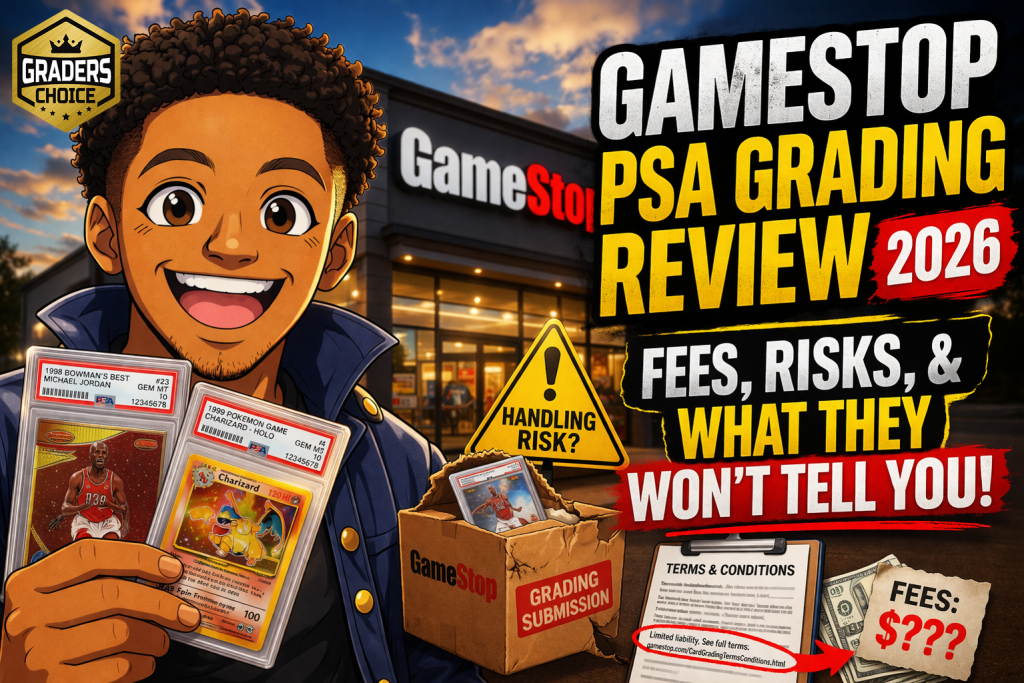
GameStop PSA grading has quickly become one of the most talked-about submission options among collectors in 2026. As more collectors look for convenient ways to submit cards, GameStop has positioned itself as a middleman between collectors and PSA. However, convenience often introduces new variables, especially during the most sensitive stage of the grading process.
Many collectors compare GameStop PSA grading to submitting directly through PSA, which involves a more hands-on process.
Before submitting through GameStop, collectors need to understand not just the fees, but also the risks, handling process, and what actually happens to your cards once they leave your hands. Because of that, this guide breaks down everything in detail so you can make a fully informed decision.
How GameStop PSA Grading Works
GameStop PSA grading operates as a third-party submission service. Instead of sending cards directly to PSA, collectors drop off or ship their cards to GameStop, which then consolidates and forwards submissions.
This process adds an additional handling layer. While that may simplify logistics for beginners, it also means your cards pass through more hands before reaching PSA. As a result, the submission chain becomes longer and more complex.
Typically, the process looks like this:
- You prepare and submit cards to GameStop
- GameStop processes and batches submissions
- Cards are shipped to PSA
- PSA grades the cards
- Cards are returned to GameStop
- GameStop returns them to you
Each step introduces potential variability, especially during handling and packaging transitions.
GameStop PSA Grading Fees in 2026
GameStop PSA grading fees are structured around convenience and accessibility. While exact pricing may vary depending on promotions or service tiers, collectors should expect a markup compared to submitting directly to PSA.
This markup reflects:
- Handling and intake processing
- Consolidated shipping logistics
- Customer-facing support
However, collectors should weigh whether the added cost aligns with the level of control they are giving up. In many cases, experienced collectors prefer direct submissions to maintain tighter oversight of their cards.
Where the Real Risk Starts: The Submission Chain
The most overlooked aspect of GameStop PSA grading is not the grading itself, but the submission chain. This is the stage where collectors are most exposed to preventable issues.
At this point, your cards are:
- Handled by store employees
- Stored temporarily
- Repackaged for shipment
- Combined with other submissions
Because of this, the risk is not theoretical. It is structural.
According to GameStop’s official terms and conditions (https://www.gamestop.com/CardGradingTermsConditions.html), responsibility for cards includes specific disclaimers and limitations around liability once items are submitted into their system.
In situations involving damage or loss, GameStop may offer remedies such as reimbursement or claims processing. However, these remedies are typically based on declared value, documentation, and internal review processes. That means the outcome may not fully reflect the card’s true market value or grading potential.
This is a critical distinction. A card’s condition before submission directly impacts its final grade, and once that condition changes, it cannot be reversed.
Handling Risk: What Happens If Your Card Is Damaged?
GameStop does acknowledge the possibility of damage or loss during the submission process. Their terms explain that they may attempt to compensate collectors under certain conditions.
However, there are important limitations:
- Claims often require proof of prior condition
- Compensation may be capped or limited
- Market fluctuations are not always accounted for
- Emotional and collector value is not recoverable
Because of that, collectors should think beyond reimbursement. The real question is whether the submission process itself is protecting the card from risk in the first place.
Once a card is mishandled, no refund can restore a lost grade.
Why This Matters to Collectors
For many collectors, grading is not just about authentication. It is about maximizing value, preserving condition, and protecting long-term investment potential.
GameStop PSA grading introduces convenience, but it also shifts control away from the collector. As a result, you are trusting a multi-step system rather than your own preparation process.
This matters because:
- Small handling mistakes can impact grades
- Surface and edge damage can occur before grading
- Submission quality directly influences outcomes
Ultimately, grading outcomes are influenced before the card ever reaches PSA.
What Collectors Should Do Next
Collectors should evaluate their priorities before choosing a submission method. If convenience is the main goal, GameStop may provide a simple entry point.
However, if control, protection, and consistency are the priority, then preparation becomes the deciding factor.
Before submitting any card:
- Inspect and clean the surface carefully
- Use proper sleeves and semi-rigid holders
- Avoid unnecessary handling
- Secure cards during transit
These steps are not optional. They are foundational to preserving card condition.
For collectors considering direct submission instead, understanding the full PSA process is critical. A complete breakdown can be found in this PSA grading guide: https://graderschoice.com/psa-card-grading/
The Most Overlooked Advantage: A Structured Prep System
The biggest gap in GameStop PSA grading is not the grading itself. It is the lack of a structured, collector-controlled preparation system before submission.
This is where experienced collectors approach things differently.
Instead of relying on fragmented supplies or in-store handling, many use a dedicated prep and submit system designed specifically for grading protection.
The Graders Choice Submission Kit was built around this exact moment in the process. Rather than acting as loose materials, it provides a structured way to sleeve, secure, and package cards before they ever enter a submission chain.
You can explore the full system here:
https://graderschoice.com/product/card-grading-submission-kit/
The goal is not to control outcomes. Instead, it is to reduce preventable risk during the stage where collectors are most exposed.
Conclusion
GameStop PSA grading in 2026 offers accessibility and convenience, especially for newer collectors. However, that convenience comes with trade-offs that should not be ignored.
The added handling layer, liability limitations, and submission chain complexity all introduce risk before the grading process even begins. While remedies may exist for damage or loss, they cannot replace the original condition of a card.
Collectors who understand this dynamic can make better decisions. Because in grading, preparation is not just a step. It is the foundation of the result.
 English